
There's a method?
We learned there were a set of steps to organizing. They made perfect sense once you knew them, but few people did. Once unveiled, the possibilities seemed endless, and we were off and running.

In our organizing journeys we’re shaped by hundreds of people along the way. Then there are a small handful who completely change the trajectory of our lives. For me, Mike Evans was one of those people. Last week I shared a post about Mike, who died on March 30.
I was about 24, serving the last few people in line at the soup kitchen where I worked in Indiana. I was proud of my work and considering where I’d been a short time ago, still surprised to be in a position to help.
I grabbed a mop and began to clean up a leak from the dish machine that’d been plaguing us all day. I wiped the sweat from my forehead and looked into the dining hall, and it hit me. Most of the people who were in line the first time I came in three years ago were there and lots of new people too. No one had starved on our watch, but the reason people needed a soup kitchen in the first place remained.
That night, I knew I was no longer satisfied mopping up the mess. I wanted to find the leak and went from serving meals to asking questions and soon a few of us who worked, volunteered, and ate at the kitchen began to talk about this, but we didn’t know what “this” was.
We had no manual on how to create change, so we just began trying things, starting with a lot of listening. Each day a few of us would sit with patrons of the kitchen to find out what people most wanted changed. The answer was consistent: housing.
We held a meeting about housing and what could be done. People came. We held a town hall meeting to raise awareness as to how bad the housing situation was. More than a hundred people showed.
We organized a rally on the courthouse square, raising more awareness and calling for action. More people came, 150 of them. The next day, our rally was on the front page of the town paper. In a few months we’d gone from nothing to lots of people getting involved and a buzz about this new group kicking up dust on housing.
But nothing changed, and we didn’t know why. Then I was invited to a meeting in Indianapolis about tenant organizing. There was a man there who seemed to know all the things about organizing that we didn’t. He talked as if there were a set of steps, a methodology to building power and winning. His name was Michael Evans.
On the sixty-mile drive home, I kept replaying the organizing phrases he used. They captured so much wisdom in so few words. When I pulled up to our place in rural Monroe County, I walked in, grabbed Mike’s card, and called. I asked if he’d come down and explain this organizing thing to us. He didn’t hesitate. “When do you want me there?”
Two weeks later, people who were homeless, public housing and trailer court residents, and a few college students crowded into our living room. Mike — around 40, a little over six feet, with sandy brown hair and sideburns — stood at an easel and scrawled on butcher paper:
“Power concedes nothing without a demand.”
He said we would not win a single thing until we had a specific demand, identified a decision-maker who could enact it, and applied direct pressure toward that person or people.
“You’ve got to make it in their self-interest to say yes, or they never will”
Everything he shared was breathtaking in its simplicity, and revelatory in what it could open up. There were a set of steps to winning change that made perfect sense once you knew them, but few people did. As Mike unveiled these fundamentals, we could see the possibilities and were off and running.
At our next few meetings, we cut our issue, and decided to run a campaign to pressure the City to create a housing trust fund to build affordable housing. We came up with a very specific demand, got clear on who had the power to enact that demand, and then a theory on what would move them to say “yes.”
About a year later, after months of organizing and action, we forced a City Council vote. We packed the room — our strongest turnout yet — and late into the night, after much debate, the council approved the fund. Just as important, some of the poorest people in our town became leaders and began to believe we could win. For me, it was the first step in finding the leak.
None of this happens without Mike Evans. There was a point in time where I had good intentions but didn’t understand enough about organizing to turn those intentions into impact. Mike broke down the fundamentals into digestible bites, and it changed my life, and the life of others who were there for that first training.
All over the world, well-meaning people come together to make change. Most of these groups struggle to build momentum and don’t understand why. Slowly people leave the group, discouraged and less likely to join next time around.
Mike showed us that if you’re reasonably good with people and follow a handful of steps, you will win tangible change in your community, and with each win, grow the number of believers, and have more power to take on even bigger fights.
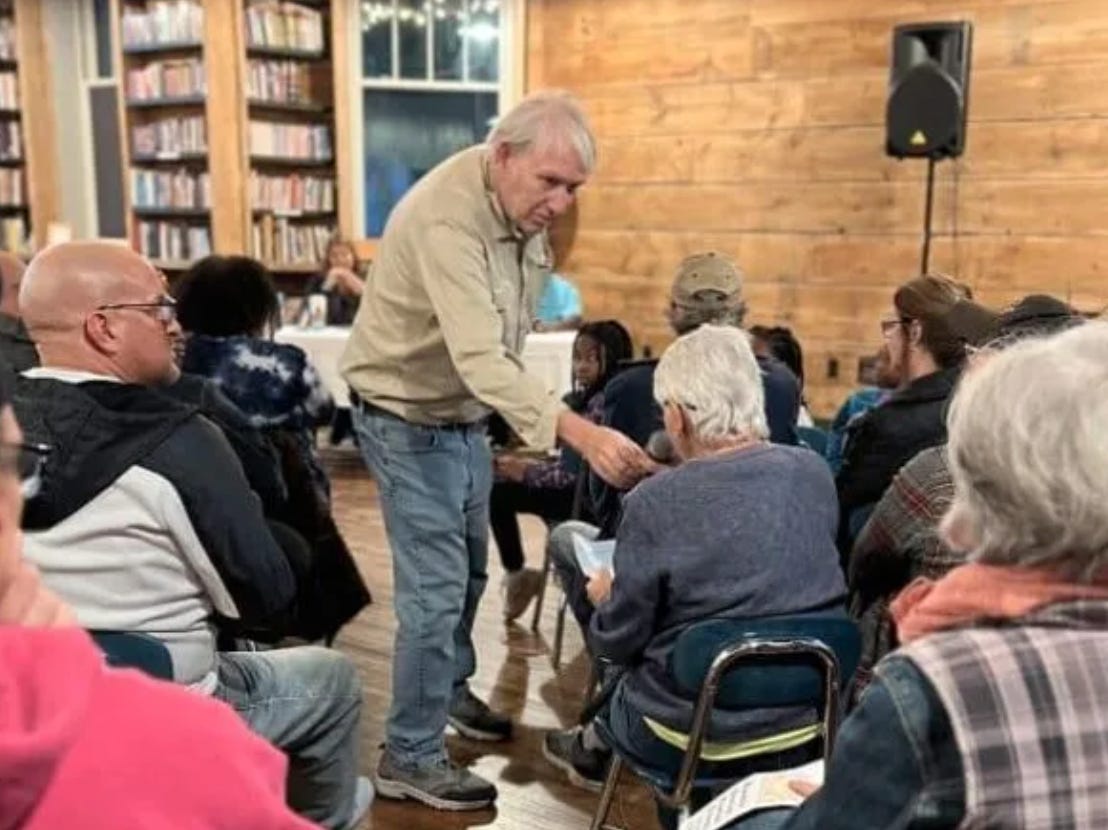
If I had to sum up the steps Mike broke down for us, it was these:
The power of widely and deeply felt issues. Organizing is SO MUCH easier if you start with an issue that lots of people are passionate about. Turnout is easier, getting people to take risks is easier, holding the group together when the chips are down is easier.
The practice of cutting an issue. Massive, structural problems feel overwhelming. Facing them, people can feel defeated before we’ve started. Build momentum by “cutting” out a discreet part of the problem, turn it into a solution and identify the person or people who can deliver. Once you get good at this, you will see the potential to organize and win everywhere.
Power analysis first. If you created a strategy without having done a power analysis, you have no strategy. Our strategy lives inside our understanding of the power held by the people we need to move AND and what most motivates them. At its simplest: What do they control? Who do they answer to? What do they want — and fear?
Strategy second. Based on that analysis, what is your theory of what will move you toward victory. Organize actions that deliver on that strategy, always conscious of the reaction you are trying to spark.
Share the work. This runs through everything. Ask people to take on real roles, prepare them, and reflect with them afterwards. None of the rest matters if we’re not actively developing more people into leaders along the way.
These steps alone won’t overhaul massive systems, but as Adam Kruggel, who was also trained by Mike, once said to me, “It’s also impossible to create that level of change, if you don’t know these organizing basics.”
Defeatism is one of the biggest barriers we face. Since that first training with Mike, I’ve found it hard to be cynical. No matter the conditions, I can see a path — a set of steps toward change. It’s not an easy path, but I can see one. That’s a gift I’m forever grateful for (thank you, Mike!), and one I hope we can share with many more people.
For those new to this column, a couple years ago, we put out a pamphlet called the Fundamentals of Community Organizing. It’s a fast read at 48 pages and spells out 37 organizing fundamentals, including a few I first learned from Mike in that country house back in Indiana.
Beautiful and hopeful post about your mentor and his impact, thanks for sharing
Your article was a great read. Of particular interest is the power analysis: those that are greedy, cruel, dishonest, irresponsible, incompetent and call for violence prime the conditions for collective action, to end their abuse of power. To use ethical legal cases combined with nonviolent popular action ground on civil rights is the solution that must prevail?